When the Proscenium Became a Picture Frame
Learn how the proscenium stage became theater’s familiar picture frame and how its design shapes what audiences see, imagine, and notice.
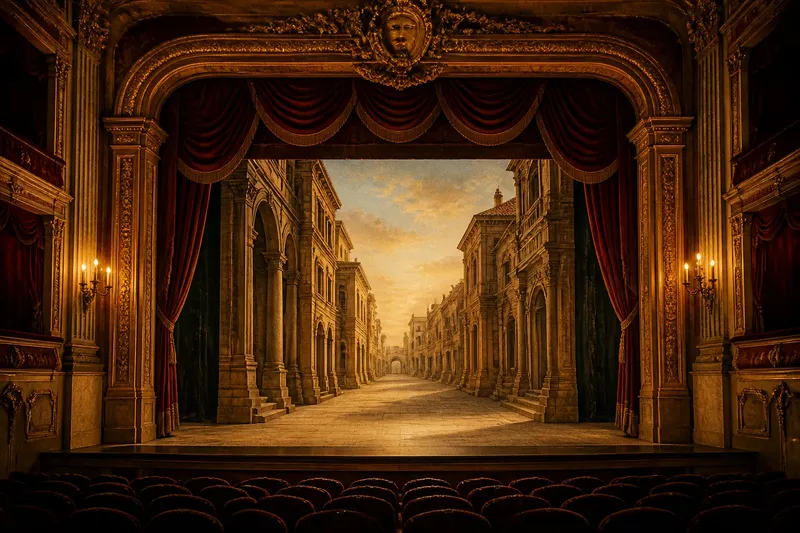
Why does a proscenium stage make an audience feel as though it is looking into a room, a palace, or a painted landscape? The proscenium stage offers a front-facing view through an architectural opening, a theatrical arrangement that came to be associated with perspective scenery and scene-changing machinery in European court theaters.
That arrangement can seem so natural that it disappears from attention. Yet it is a designed relationship: actors perform beyond a visible boundary, scenery supplies a view, and the audience watches from outside. Understanding the proscenium as a picture frame means noticing both the historical settings in which it took shape and the habits it invites.
Proscenium stage basics
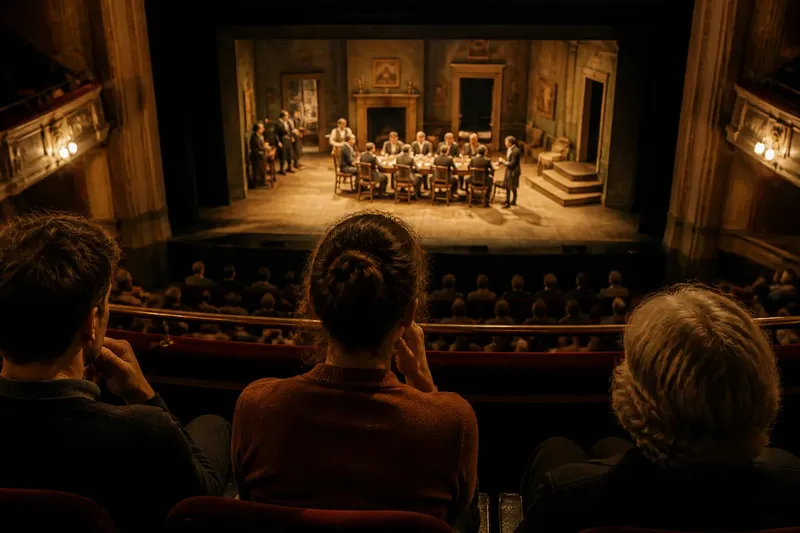
A proscenium stage places the audience on one side of the playing area, facing an opening that separates stage from auditorium. The opening is commonly called the proscenium arch; in some theaters, the boundary is formed by architectural and scenic elements rather than a prominent stone or decorative arch.
A curtain, side walls, and overhead structure can make the opening look like a border around a complete picture. Behind it, scenery may suggest a single room or stretch into deep perspective. The audience’s view is organized from the front rather than wrapping around the action.
“Picture frame” is a useful description, not a rule. A production can leave the stage bare, expose its machinery, or let performers address the audience directly. The proscenium establishes a convention that artists can use, bend, or reject.
A gradual stage convention
The proscenium did not emerge as one invention with one universal purpose. In Renaissance Italy, court entertainments and theatrical experiments developed alongside perspective scenery and scenic machinery. The Teatro Olimpico in Vicenza, designed by Andrea Palladio and completed after his death, is an early surviving theater with a permanent architectural setting and perspective streets behind the stage. It is not a simple model for every later proscenium, but it helps show how architecture and scenic illusion could work together.
In later European court theaters, framed openings and perspective scenery offered a way to present carefully composed views. Curtains and scenery could conceal changes, while the audience stayed in place. The details varied across theaters and periods, so the proscenium is better understood as a developing convention than as a design with a single point of origin.
The form also served more than illusionistic drama. Proscenium theaters hosted spectacle, comedy, music, and performance styles that made theatrical artifice visible. Its enduring feature is not one genre but a durable arrangement of spectators facing a bounded playing space.
How the picture effect works
The proscenium concentrates attention within a bounded opening. Scenic designers can use perspective, color, and carefully placed doors or windows to direct the eye. Like a framed image, the scene has edges: what appears inside them receives emphasis, while the auditorium sits outside the composition.
Perspective scenery can strengthen the effect. Lines in a painted floor or architectural backdrop may converge toward a distant point, giving a flat or shallow arrangement an impression of depth. The eye supplies a continuous space, even though the scene is assembled from practical materials, controlled lighting, and a chosen viewing angle.
The resemblance has limits. A painting remains still, while a theatrical scene changes in time; actors enter, leave, speak, and alter what the audience understands. The frame organizes a live event, and the event can draw attention to the frame itself.
What the frame asks?
Most directly, the proscenium asks spectators to accept a particular point of view. The audience watches from outside the represented space, often from a fixed seat, and follows action arranged to read clearly from the front. A room may have several visible walls, but its open side is understood as an invitation to look in.
That convention can shape performers’ relationship with spectators. In a strongly illusionistic production, actors may behave as if no one is watching them. They can speak to one another without acknowledging the auditorium, even though their voices and gestures are intended for the people beyond the frame.
Many productions play with this agreement. An actor might turn outward to address the audience, a set might reveal its supports, or a scene might shift from an imagined room to a bare stage. These choices change the terms of attention: spectators can watch the story, the making of the story, or the tension between them.
The arrangement can also make the action feel complete and self-contained. A framed scene may encourage spectators to treat what is shown as the relevant world, even when the script hints at events beyond the visible room. Recognizing that effect helps an audience distinguish a character’s limited view from the production’s wider perspective.
Other theater layouts
Not every theater uses a picture frame. In a thrust theater, the stage projects into the audience, which sits on several sides. An arena arrangement places spectators around the playing area; theater-in-the-round has no single front. Black-box spaces can be rearranged to suit a production, while a found space might use an existing room, courtyard, or hall.
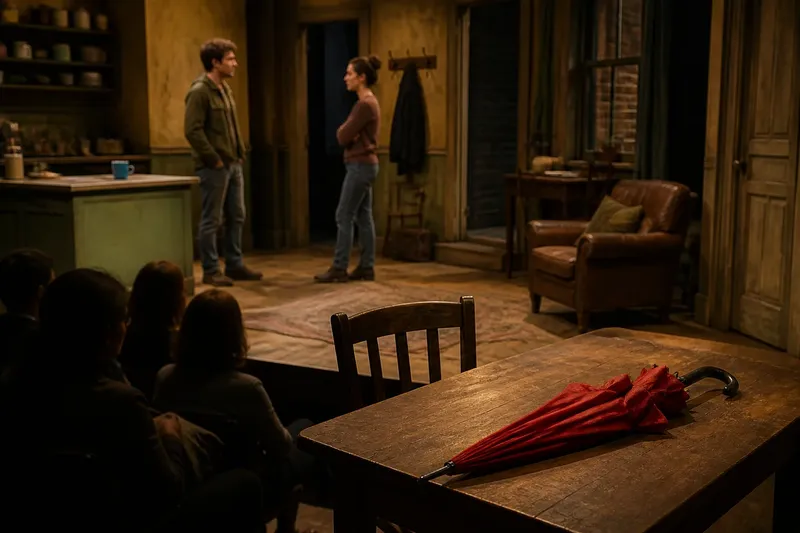
These layouts change the practical choices available to artists. A performer in the round may need to turn and redistribute attention so no section of the audience is left watching a back. In a thrust space, scenery has to preserve sightlines across the stage. A proscenium, by contrast, can support a broad, carefully composed view and hide equipment beyond the audience’s direct line of sight.
None of these forms is inherently more truthful or more engaging. A framed stage can make its construction conspicuous, and an arena production can still create a strong illusion. The useful question is what the arrangement lets the production show, conceal, or emphasize.
Scenery and curtains
The proscenium opening provides a working boundary for scenic design. A theater may use a main curtain, side masking, overhead scenery, or a decorative border to adjust how much of the stage the audience sees. These elements can create a distinct picture, but they also conceal backstage activity and equipment.
Perspective scenery works best from its intended viewing area. A painted corridor might appear to stretch away from the auditorium, while flats create a room with an open side facing spectators. From a sharply different angle, some lines or relationships may look less convincing; from the usual seating area, the scene may cohere.
Modern productions need not imitate a finished picture. Designers may use platforms, a visible lighting rig, or an empty stage framed by the arch. The opening can feel like a window, a threshold, a screen, or simply the edge of the performance area.
Reading a proscenium stage
Start by noticing where the frame directs your attention. Does the scenery pull your eye toward a doorway, a central table, or a distant backdrop? Does lighting isolate one part of the stage while leaving the rest in shadow? These choices reveal how the production composes its view.
Then watch for moments that complicate your position. An actor may face out, a curtain may remain open during a scene change, or a set may show its unfinished edges. Ask what changes: does the moment invite you into the fictional world, remind you that you are watching a performance, or make both possibilities visible?
Say you attend an imagined production whose first scene presents a painted parlor, with actors behaving as if the audience were absent. Later, they move the furniture in full view and address the spectators directly. The observable result is a shift in how you read the parlor: first as a believable room, then as an image the company is actively constructing.
It is not worth trying to decide whether the production has “broken” the proscenium convention. The convention is flexible; its meaning lies in the relationship between the frame, the action, and the audience’s attention.
Proscenium questions?
Is the proscenium the arch or the whole stage?
Strictly, the proscenium is the architectural opening that separates the stage from the auditorium. In everyday discussion, “proscenium stage” refers to the broader arrangement, including the audience seated in front of that opening.
Did the proscenium begin with realistic plays?
No. The framed stage developed alongside perspective scenery and theatrical spectacle, and it has served many performance styles. Realistic drama is one use of the form, not its sole purpose.
Why do actors sometimes ignore the audience?
Ignoring spectators can help sustain the sense that the action belongs to a separate fictional world. Other productions choose direct address or visible acknowledgment, using the same auditorium relationship differently.
Is a proscenium stage less immersive?
Not automatically. It creates physical and visual distance, but performance, sound, scenery, and storytelling can still make an audience feel closely involved. Immersion depends on more than whether spectators surround the stage.
The frame in view
The proscenium’s picture-frame quality is a convention audiences can recognize without treating it as a command. It offers a front-facing view, gives scenery a boundary, and lets artists shape attention; it can also be exposed or challenged whenever a production wants spectators to notice the act of looking.
Next time the curtain rises, notice not only what appears inside the opening but also what the frame leaves out. That small distinction can reveal how a production guides your attention—and where it asks you to imagine beyond the visible scene.